Been reading Tim Winton's early novel Shallows. Been wondering about the impact of being a copper's son - how it affects your childhood and how much it has impacted the content of his writing.
In terms of Shallows - I tried this haiku about it:
Tim is deeply suspicious
of small towns, especially
Ones where men hunt whales.
More later.
Thursday, September 18, 2008


Sunday, September 7, 2008
In Burgess
“What d’ya reckon ‘In Burgess’ would be like?” In Burgess… I was in the queue at the Sun cinema to go see In Bruges. I looked around to see who it was who was asking the question. I wanted to say “It’s Bruges (pronounced Brooooje) actually” but this isn’t correct either. It’s only pronounced like this in the English speaking world. If you are really “in Bruges”, I think I recall the pronunciation as “Broogger”. It’s a complicated thing. It’s a thing which you can so easily get wrong and something which becomes a marker of who you are and where you’ve been.
Which is sort of what the film is about. The two main characters are trying to lay low in the tourist-filled medieval town of Bruges in Belgium because one of them, Ray, has done something really horrible. They both do horrible things for a living but one character, Ken, is more accustomed to the personal impacts of his chosen career as a hired killer.
We follow Ray and Ken around the medieval churches as Ray tries to come to terms with what he has done. Paintings of medieval views of purgatory and of the last day on earth form the backdrop for both men. Is it possible to find redemption when you have committed an evil act? What’s the place of hell and heaven? What happens if you’re only a little bit bad? The director counter-balances the scenes of medieval Europe with a sort of modern, sometimes comic nastiness. We meet a young drug dealer and her skinhead boyfriend. A guns dealer who works out of a cornucopia of antiques and fine arts. A cocaine sniffing dwarf and his Dutch prostitute. Modern life looks pretty dissolute. There’s a film within a film construct enables the film to include a large number of people dressed in fantasy costumes with animal masks or animal heads; these people appear and reappear at the periphery like a version of a bachannale gone wrong. The only ‘normal’ person we meet is the owner of the hotel where Ray and Kenny stay. She provides a kind of moral pivot for the range of strange activities around her.
And in a funny way, the two bad men do as well. The film explores notions of honour, integrity and loyalty through the two main characters and supporting actor Ralph Fiennes. The difficult choices made by all three characters stem from the strict moral codes which they were born into. It feels strange using the term “moral codes” to describe their thinking but all three have clear ideas about good and evil and about how you treat people which are as much a moral code as mine and maybe not too far away; it’s just that I am not in the habit of killing people. So it’s sort of interesting to position this type of Sopranos thinking in Bruges, with its facade of medieval trappings.
It’s not a great film but not a terrible one either. There is some great, laugh out loud comic dialogue. The shoot-out scenes need work. One reviewer called it “Mr. McDonagh’s modest bag of tricks”. He’s right. The film doesn't quite work because Bruges is not a place of brooding medieval nastiness but a more sterile and tidy tourist town. It needed to be set in a slightly edgier place, maby St Petersburg; a place which combines tourism and a dark Russian underbelly(by all accounts, I haven't been there).
But I liked being back in Bruges. I spent some time in Bruges about 15 years ago. I remembered chocolate shops, extreme tidiness and fruit-flavoured beer. It was a tourist construct; full of shops for the well-heeled and opportunities for culture. I hadn’t remembered any of the churches and so, when I re-read my dairy of the trip last night, I wasn’t surprised to see the phrase “I am sick of churches”. I bet we didn’t go into any of them. We did go into a tower where a lot of the film action takes place; I have written “We climbed lots of stairs because there is supposed to be a great view but the 70-odd people in front of us at the top made it difficult to appreciate.” We went on two excellent tours; one on bikes around the city and out into the countryside and a whole day bus tour to explore World War 1 battle sites which was a highlight of our time in Europe. We stayed in a smelly youth hostel outside of the beautiful old town and bought expensive but divine chocolates. We felt like outsiders because all of the old city felt like a construct. And because it was expensive. Just as the two hit men feel like outsiders. But not my friend in cinema queue who doesn't know what she doesn't know and therefore doesn't know about her outsiderness (if that's a word).
In Bruges, we rested. We had not quite enough money to really enjoy everything. We learnt how to pronounce Bruges…But we might have been in Burgess…
Which is sort of what the film is about. The two main characters are trying to lay low in the tourist-filled medieval town of Bruges in Belgium because one of them, Ray, has done something really horrible. They both do horrible things for a living but one character, Ken, is more accustomed to the personal impacts of his chosen career as a hired killer.
We follow Ray and Ken around the medieval churches as Ray tries to come to terms with what he has done. Paintings of medieval views of purgatory and of the last day on earth form the backdrop for both men. Is it possible to find redemption when you have committed an evil act? What’s the place of hell and heaven? What happens if you’re only a little bit bad? The director counter-balances the scenes of medieval Europe with a sort of modern, sometimes comic nastiness. We meet a young drug dealer and her skinhead boyfriend. A guns dealer who works out of a cornucopia of antiques and fine arts. A cocaine sniffing dwarf and his Dutch prostitute. Modern life looks pretty dissolute. There’s a film within a film construct enables the film to include a large number of people dressed in fantasy costumes with animal masks or animal heads; these people appear and reappear at the periphery like a version of a bachannale gone wrong. The only ‘normal’ person we meet is the owner of the hotel where Ray and Kenny stay. She provides a kind of moral pivot for the range of strange activities around her.
And in a funny way, the two bad men do as well. The film explores notions of honour, integrity and loyalty through the two main characters and supporting actor Ralph Fiennes. The difficult choices made by all three characters stem from the strict moral codes which they were born into. It feels strange using the term “moral codes” to describe their thinking but all three have clear ideas about good and evil and about how you treat people which are as much a moral code as mine and maybe not too far away; it’s just that I am not in the habit of killing people. So it’s sort of interesting to position this type of Sopranos thinking in Bruges, with its facade of medieval trappings.
It’s not a great film but not a terrible one either. There is some great, laugh out loud comic dialogue. The shoot-out scenes need work. One reviewer called it “Mr. McDonagh’s modest bag of tricks”. He’s right. The film doesn't quite work because Bruges is not a place of brooding medieval nastiness but a more sterile and tidy tourist town. It needed to be set in a slightly edgier place, maby St Petersburg; a place which combines tourism and a dark Russian underbelly(by all accounts, I haven't been there).
But I liked being back in Bruges. I spent some time in Bruges about 15 years ago. I remembered chocolate shops, extreme tidiness and fruit-flavoured beer. It was a tourist construct; full of shops for the well-heeled and opportunities for culture. I hadn’t remembered any of the churches and so, when I re-read my dairy of the trip last night, I wasn’t surprised to see the phrase “I am sick of churches”. I bet we didn’t go into any of them. We did go into a tower where a lot of the film action takes place; I have written “We climbed lots of stairs because there is supposed to be a great view but the 70-odd people in front of us at the top made it difficult to appreciate.” We went on two excellent tours; one on bikes around the city and out into the countryside and a whole day bus tour to explore World War 1 battle sites which was a highlight of our time in Europe. We stayed in a smelly youth hostel outside of the beautiful old town and bought expensive but divine chocolates. We felt like outsiders because all of the old city felt like a construct. And because it was expensive. Just as the two hit men feel like outsiders. But not my friend in cinema queue who doesn't know what she doesn't know and therefore doesn't know about her outsiderness (if that's a word).
In Bruges, we rested. We had not quite enough money to really enjoy everything. We learnt how to pronounce Bruges…But we might have been in Burgess…
Monday, September 1, 2008
Netherland Part 11
Spring is coming to Melbourne and with it the great treat it is to sit outside in the sun and read for a few hours. On Friday I finished Netherland in the back garden with the jasmine about to go gangbusters and the cat lurking, a bit scared of the new crop of stray cats that have suddenly appeared with the warmer weather.
As I said in an earlier post, I loved going to bed to read this book. It’s set in the context of 9/11 in New York and a lot of reviewers have fixated on this but it seems to me that the novel is as much or more about the micro – about narrator Hans van den Broek and the wake up call that occurs in his life. In that way, 9/11 is a kind of large metaphor. How it works is this; after 9/11. Hans’ wife Rachel takes herself and their baby back to her country of birth, England. It has freaked her out; she doesn’t feel safe. Hans is left behind, renting an expensive apartment in the famous old Chelsea Hotel. “Over half the rooms were occupied by longterm residents who by their furtiveness and ornamental diversity reminded me of the population of the aquarium I’d kept as a child.” It’s appropriate for him to be living in this sort of zoo; he is totally disconnected from his environment, family and sense of what is important.
I think women love stories about hapless men like this. Hans does futures predictions for the money market so even his job is totally disconnected from any sort of reality. I just wanted him to get himself sorted. In reality, I am not attracted to haplessness at all – I seem to like competent men who can do practical things. Hans would be extremely annoying.
He is the archetypal outsider. He is Dutch but has lived in London and now New York. He has no living family. He plays cricket which has got to be an outsider’s game in the Netherlands as it is America. His presence in the novel is matched by another outsider, Chuck Ramkissoon who is from Trinidad. He is a businessman who dabbles in dodgy deals as well as providing kosher sushi to the residents of Long Island. Chuck subscribes to the American dream – If you build it, they will come. He’s full of schemes. And subscribes to the mythology of cricket – we meet him when he intervenes when a gun is brandished at a cricket match with a lecture about the civilising impact of cricket.
And while the novel spends some time on cricket, it is really about family and identity. One of the most moving scenes in the novel is when Hans stalks his far-away son and wife via Google Earth, tracking down to the roof line of their house, searching for signs of life; signs that he was part of their life and signs of their abandonment of him. We can be increasingly in pixilated contact with anyone but how do we really make contact or have intimacy? Which is the real story of the book. For the greater part of the book, Hans has more contact with Chuck than with anyone else in his life. It’s a novel about a man finding out what is important. Let me give an example of how he writes about this:
The novel is also about identity. The title reminds us that this area of the United States was originally called New Netherland. Wikipedia says that “New Netherland has left a profoundly enduring legacy on both American cultural and political life. Perhaps most significant was the impact of cultural and religious tolerance which led to a wealth of diversity in New Amsterdam.” The attack on 9/11 is partly about the politics of identity, about demonisation, about marginalisation. About being outsiders. Young disconnected men.
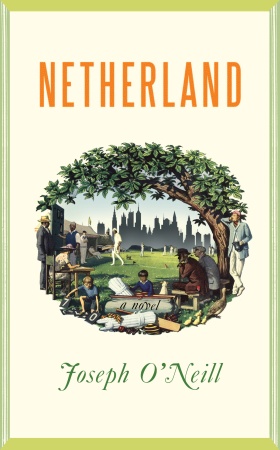
Hans is a global citizen; the anchors of family are gone, he can work anywhere. Information and culture have been globalised. In an interview, the author, who has Irish and Turkish heritage, who grew up in the Netherlands and Britain, who works in New York said that half way through writing it, he realised that the plot is the same as The Great Gatsby. He said that it’s about “...saying goodbye to Gatsby, Gatsby lived in an America which no longer exists”. It pays homage to the great tradition in American novels and political life – the dream. And thinking about the language used around the current US elections, the notion of the American dream is still so potent. If it were a tag cloud, it would be huge. For both Obama and McCain. Its worth looking at the American cover of the book - a pastoral idyll and comparing it with the one I bought. They tell very different stories. On my cover, there is a cropped image of someone, probably male, skating. It may be on thin ice or it may reference the more nostalgic parts of Hans' childhood. It's edgy and energetic in a way that the US cover is not.
Finally the writing. Dwight Garner, writing for the International Herald Tribune says that O’Neill is “incapable of composing a boring sentence or thinking an uninteresting thought,...(e.g.)he's writing about dating ("We courted in the style preferred by the English: alcoholically")”. Like me he really loved the book but O'Neill's style won’t be for everyone. “But here's what "Netherland" surely is: the wittiest, angriest, most exacting and most desolate work of fiction we've yet had about life in New York and London after the World Trade Center fell.”
Another columnist, Sean O'Hagen, has written an interesting article about the novel and its fascination with cricket - it's worth reading it just for his list of great novels which are about sport. He says it recalls "John Updike's paeans to basketball that run like an elegy for lost youth, and lost Americal innocence, through his epic series of Rabbit novels." It made me remember the great passsages in Couples; the Sunday afternoon basketball matches where everything seems to be at stake in a way that it NEVER would be for Hans. Where is his testosterone?
For me, it’s about the desolation of life, of relationship, of work which has no meaning or value. Desolation in Nether nether land…
And finally, to amuse myself before I went to sleep, I made a haiku - seems a bit naff to include it here but hey - it's my blog.
As I said in an earlier post, I loved going to bed to read this book. It’s set in the context of 9/11 in New York and a lot of reviewers have fixated on this but it seems to me that the novel is as much or more about the micro – about narrator Hans van den Broek and the wake up call that occurs in his life. In that way, 9/11 is a kind of large metaphor. How it works is this; after 9/11. Hans’ wife Rachel takes herself and their baby back to her country of birth, England. It has freaked her out; she doesn’t feel safe. Hans is left behind, renting an expensive apartment in the famous old Chelsea Hotel. “Over half the rooms were occupied by longterm residents who by their furtiveness and ornamental diversity reminded me of the population of the aquarium I’d kept as a child.” It’s appropriate for him to be living in this sort of zoo; he is totally disconnected from his environment, family and sense of what is important.
I think women love stories about hapless men like this. Hans does futures predictions for the money market so even his job is totally disconnected from any sort of reality. I just wanted him to get himself sorted. In reality, I am not attracted to haplessness at all – I seem to like competent men who can do practical things. Hans would be extremely annoying.
He is the archetypal outsider. He is Dutch but has lived in London and now New York. He has no living family. He plays cricket which has got to be an outsider’s game in the Netherlands as it is America. His presence in the novel is matched by another outsider, Chuck Ramkissoon who is from Trinidad. He is a businessman who dabbles in dodgy deals as well as providing kosher sushi to the residents of Long Island. Chuck subscribes to the American dream – If you build it, they will come. He’s full of schemes. And subscribes to the mythology of cricket – we meet him when he intervenes when a gun is brandished at a cricket match with a lecture about the civilising impact of cricket.
And while the novel spends some time on cricket, it is really about family and identity. One of the most moving scenes in the novel is when Hans stalks his far-away son and wife via Google Earth, tracking down to the roof line of their house, searching for signs of life; signs that he was part of their life and signs of their abandonment of him. We can be increasingly in pixilated contact with anyone but how do we really make contact or have intimacy? Which is the real story of the book. For the greater part of the book, Hans has more contact with Chuck than with anyone else in his life. It’s a novel about a man finding out what is important. Let me give an example of how he writes about this:
“…our dealings, however unusual and close, were the dealings of businessman. My ease with this state of affairs no doubt reveals a shortcoming on my part, but its the same quality that enables me to thrive at work, where so many of the brisk, tough, successful men I meet are secretly sick to their stomachs about their quarterlies, are being eaten alive by bosses and clients and all-seeing wives and judgemental offspring, and are, in sum, desperate to be taken at face value and very happy to reciprocate the courtesy. This chronic and I think, peculiarly male strain of humiliation explains the slight affection which bonds so many of us, but such affection depends on a certain reserve. Chuck observed the code, and so did I; neither pressed the other on delicate subjects.” (p158)
The novel is also about identity. The title reminds us that this area of the United States was originally called New Netherland. Wikipedia says that “New Netherland has left a profoundly enduring legacy on both American cultural and political life. Perhaps most significant was the impact of cultural and religious tolerance which led to a wealth of diversity in New Amsterdam.” The attack on 9/11 is partly about the politics of identity, about demonisation, about marginalisation. About being outsiders. Young disconnected men.
Hans is a global citizen; the anchors of family are gone, he can work anywhere. Information and culture have been globalised. In an interview, the author, who has Irish and Turkish heritage, who grew up in the Netherlands and Britain, who works in New York said that half way through writing it, he realised that the plot is the same as The Great Gatsby. He said that it’s about “...saying goodbye to Gatsby, Gatsby lived in an America which no longer exists”. It pays homage to the great tradition in American novels and political life – the dream. And thinking about the language used around the current US elections, the notion of the American dream is still so potent. If it were a tag cloud, it would be huge. For both Obama and McCain. Its worth looking at the American cover of the book - a pastoral idyll and comparing it with the one I bought. They tell very different stories. On my cover, there is a cropped image of someone, probably male, skating. It may be on thin ice or it may reference the more nostalgic parts of Hans' childhood. It's edgy and energetic in a way that the US cover is not.
Finally the writing. Dwight Garner, writing for the International Herald Tribune says that O’Neill is “incapable of composing a boring sentence or thinking an uninteresting thought,...(e.g.)he's writing about dating ("We courted in the style preferred by the English: alcoholically")”. Like me he really loved the book but O'Neill's style won’t be for everyone. “But here's what "Netherland" surely is: the wittiest, angriest, most exacting and most desolate work of fiction we've yet had about life in New York and London after the World Trade Center fell.”
Another columnist, Sean O'Hagen, has written an interesting article about the novel and its fascination with cricket - it's worth reading it just for his list of great novels which are about sport. He says it recalls "John Updike's paeans to basketball that run like an elegy for lost youth, and lost Americal innocence, through his epic series of Rabbit novels." It made me remember the great passsages in Couples; the Sunday afternoon basketball matches where everything seems to be at stake in a way that it NEVER would be for Hans. Where is his testosterone?
For me, it’s about the desolation of life, of relationship, of work which has no meaning or value. Desolation in Nether nether land…
And finally, to amuse myself before I went to sleep, I made a haiku - seems a bit naff to include it here but hey - it's my blog.
Post 9/11
Hans foolishly substituted
Cricket for marriage.
Sunday, August 31, 2008
HEY YOU. The living!
The lasting legacy of the film festival has been a snobby disdain for ordinary films. So yesterday, I ventured off to see the Swedish film You, the living with my fabulous film festival friend (FFFF). We had to see it because David Stratton described it as a ”must for serious cinema buffs” or words to that effect. We were in search of something different; beyond “nice little films”.
You, the living is a sort of shout of a title. It’s in your face in a way that the film is not. It’s demanding something of us. “Hey you” – it’s saying. “Take some notice. This is important.” Because the opposite is what – we, the dead? It comes from Goethe: “Be pleased then, you, the living, in your delightfully warmed bed, before Lethe's ice-cold wave will lick your escaping foot.” Early in the film a tram pulls up. Its destination is "Lethe". People spill out and the tram moves on. I knew that Lethe meant “forgetfulness” but Wikipedia also says "In Classical Greek, Lethe literally means "forgetfulness" or "concealment". It’s related to the Greek word for "truth", meaning "un-forgetfulness" or "un-concealment". In Greek mythology, Lethe is one of the several rivers of Hades: those who drank from it experienced complete forgetfulness." In the film’s context, I think it means “Don’t forget you are alive, be alive to the ephemeralness of our condition. Get off the tram!” Or maybe that’s just my current take on things.
Certainly the other part of the quote is at odds with much of the activity in the film. There is little in the film to suggest “delightfully warmed bed”. It’s shot in a limey institutional green; the interiors of houses, street scenes, bars and deserted office foyers tinged in a brooding green sepia. I loved the colour; it created a consistent link between the 50 vignettes of the film and added to the impression that I had of floating like a dust mote through the film. There is no grand plot although one reviewer I read quoted film maker Roy Andersson as saying the film is “about the vulnerability of human beings”.
I warmed to the film over time. Early scenes, such as a surreal china-smashing, execution-causing vignette seemed to try too hard; I was reminded of Monty Python but not in a good way. Similarly a singing scene where a son puts the hard word on his father for cash. And yet other much more ordinary scenes seemed filled with the pathos of being alive. The overweight woman with the beautiful mouth feels ugly and depressed. Nothing her partner can do or say will make her feel better. She tells him to piss off; we’ve all been there. The psychiatrist is tired of working with people who can’t be happy; they are mean at heart. The film allowed you thinking space; I floated off thinking about a friend whose middle name is schadenfreude. (I saw her recently and I was struck with how tiring it is to be with her because of her meanness.) The lack of a strong plot line allowed space for a much more significant personal interaction with the film while it was screening.
And the most beautiful scene for me is the wedding dream. A young girl tells the bar crowd “I dreamt that I married Micke” (the lead guitarist in a band). Her dream is the culmination of a series of fantasies about Micke and an actual meeting. Every teenager has had the “meet the rock star” gauche moment or has dreamt of it. Her post wedding fantasy has a lyrical beauty about it, she gorgeous in wedding dress, opening presents, he wedded to guitar, playing lovely, lovely music. The scene morphs into a surreal train journey and they pull into a station to be greeted by an adoring crowd. But also as Naomi, my FFFF pointed out, underneath the lyricism is a reality; he is much more in love with himself, his guitar and the crowd (in that order) than her so the relationship is pretty doomed.
I was reminded of many of the European films I saw in the 70s. I think the connection is the interest in the surreal and in the disturbance of the surburban veneer to uncover both the ordinariness and the vulnerability of the human condition. One wonderful scene illustrates this. A man is on a balcony as night falls. Across from him, through a window, we can see the tail-end of a bizarre silly scene that we, the film watchers have been up close to prior to this scene but the watcher seems largely oblivious to it. From another room, we hear his wife asking ”What are you thinking?” He is smoking. Not thinking, smoking. And probably scratching his balls. Again she pleads “What are you thinking?” We know that he is thinking of nothing, just daydreaming with his cigarette. She is seeking to connect. He is not deliberately evasive; just not on her wavelength. And she not on his. The human condition.
I thought a lot of Bunuel while I was watching the film and was pleased to read a similar thought in a review by Philip French in The Observer: “Some years later, after marrying a Swede, I gave myself a crash course in Scandinavian culture that revealed a conventional wisdom claimed not to exist - the Scandinavian sense of humour. This is a mordant, quirky, melancholic affair, exhibited by that archetypal malcontent Hamlet, and to be found in, among others, Ibsen, Hans Andersen, Strindberg, Bergman, Astrid Lindgren and Frans G Bengtsson's wonderful adventure novel The Long Ships. Both movies (he means this and Andersson’s third film) are tragicomedies. If they belong in an artistic tradition, it would be Surrealism or the theatre of the absurd and their particular affinities are with Buñuel and Ionesco.”
Lovely to see a film, even though I was irritated by parts of it, that let you float in a river of associations and feelings. It’s Andersson’s fourth in four decades; he is 64 and maybe that’s where Lethe’s ice-cold foot finds real bite.
You, the living is a sort of shout of a title. It’s in your face in a way that the film is not. It’s demanding something of us. “Hey you” – it’s saying. “Take some notice. This is important.” Because the opposite is what – we, the dead? It comes from Goethe: “Be pleased then, you, the living, in your delightfully warmed bed, before Lethe's ice-cold wave will lick your escaping foot.” Early in the film a tram pulls up. Its destination is "Lethe". People spill out and the tram moves on. I knew that Lethe meant “forgetfulness” but Wikipedia also says "In Classical Greek, Lethe literally means "forgetfulness" or "concealment". It’s related to the Greek word for "truth", meaning "un-forgetfulness" or "un-concealment". In Greek mythology, Lethe is one of the several rivers of Hades: those who drank from it experienced complete forgetfulness." In the film’s context, I think it means “Don’t forget you are alive, be alive to the ephemeralness of our condition. Get off the tram!” Or maybe that’s just my current take on things.
Certainly the other part of the quote is at odds with much of the activity in the film. There is little in the film to suggest “delightfully warmed bed”. It’s shot in a limey institutional green; the interiors of houses, street scenes, bars and deserted office foyers tinged in a brooding green sepia. I loved the colour; it created a consistent link between the 50 vignettes of the film and added to the impression that I had of floating like a dust mote through the film. There is no grand plot although one reviewer I read quoted film maker Roy Andersson as saying the film is “about the vulnerability of human beings”.
I warmed to the film over time. Early scenes, such as a surreal china-smashing, execution-causing vignette seemed to try too hard; I was reminded of Monty Python but not in a good way. Similarly a singing scene where a son puts the hard word on his father for cash. And yet other much more ordinary scenes seemed filled with the pathos of being alive. The overweight woman with the beautiful mouth feels ugly and depressed. Nothing her partner can do or say will make her feel better. She tells him to piss off; we’ve all been there. The psychiatrist is tired of working with people who can’t be happy; they are mean at heart. The film allowed you thinking space; I floated off thinking about a friend whose middle name is schadenfreude. (I saw her recently and I was struck with how tiring it is to be with her because of her meanness.) The lack of a strong plot line allowed space for a much more significant personal interaction with the film while it was screening.
And the most beautiful scene for me is the wedding dream. A young girl tells the bar crowd “I dreamt that I married Micke” (the lead guitarist in a band). Her dream is the culmination of a series of fantasies about Micke and an actual meeting. Every teenager has had the “meet the rock star” gauche moment or has dreamt of it. Her post wedding fantasy has a lyrical beauty about it, she gorgeous in wedding dress, opening presents, he wedded to guitar, playing lovely, lovely music. The scene morphs into a surreal train journey and they pull into a station to be greeted by an adoring crowd. But also as Naomi, my FFFF pointed out, underneath the lyricism is a reality; he is much more in love with himself, his guitar and the crowd (in that order) than her so the relationship is pretty doomed.
I was reminded of many of the European films I saw in the 70s. I think the connection is the interest in the surreal and in the disturbance of the surburban veneer to uncover both the ordinariness and the vulnerability of the human condition. One wonderful scene illustrates this. A man is on a balcony as night falls. Across from him, through a window, we can see the tail-end of a bizarre silly scene that we, the film watchers have been up close to prior to this scene but the watcher seems largely oblivious to it. From another room, we hear his wife asking ”What are you thinking?” He is smoking. Not thinking, smoking. And probably scratching his balls. Again she pleads “What are you thinking?” We know that he is thinking of nothing, just daydreaming with his cigarette. She is seeking to connect. He is not deliberately evasive; just not on her wavelength. And she not on his. The human condition.
I thought a lot of Bunuel while I was watching the film and was pleased to read a similar thought in a review by Philip French in The Observer: “Some years later, after marrying a Swede, I gave myself a crash course in Scandinavian culture that revealed a conventional wisdom claimed not to exist - the Scandinavian sense of humour. This is a mordant, quirky, melancholic affair, exhibited by that archetypal malcontent Hamlet, and to be found in, among others, Ibsen, Hans Andersen, Strindberg, Bergman, Astrid Lindgren and Frans G Bengtsson's wonderful adventure novel The Long Ships. Both movies (he means this and Andersson’s third film) are tragicomedies. If they belong in an artistic tradition, it would be Surrealism or the theatre of the absurd and their particular affinities are with Buñuel and Ionesco.”
Lovely to see a film, even though I was irritated by parts of it, that let you float in a river of associations and feelings. It’s Andersson’s fourth in four decades; he is 64 and maybe that’s where Lethe’s ice-cold foot finds real bite.
Wednesday, August 27, 2008
Animating animation?
Is it a problem if a film, which is about terror and persecution and alienation, is also visually entrancing? When you sit there semi-glued, thinking that almost any scene would look good and/or striking, as a greeting card? I went to see the film Persepolis with my niece Grace. It is the story of a young Iranian girl who grows up in the time of the Shah in Tehran to left wing parents who live with some fear of persecution; relatives are in jail and have been tortured. The main character, Marjane, is bolshie and vulnerable when the revolution comes because of her outspokenness. As a teenager, she is sent to Vienna to school and thus begins a complex time in her life.
Like any outsider, she finds it hard to make friends and this is complicated by the fact that she finds it hard to organise a sympathetic place to live. One review I read said that the writer, Marjane Satrapi, is setting up Europe as hospitable on the surface but, in contrast with Iranians, there is no real sense of community and when the chips are down… Well home is better, whatever the politics. This sentiment is sort of belied by the ending and my sense that the dichotomy is false. An outsider in any society can have a pretty alienating time. And Marjane has an extreme reaction to some of the events, which take place in Europe.
The film provides a brief political history of the last 30 years in Iran, with a particular focus on what happens to women. It is great – really accessible, especially for my 15-year-old niece who is pretty savvy. But you don’t need to be really savvy to get it.
What I struggled with ultimately was the form of the film. It’s animated. It’s incredibly stylish to look at in its black and white simple 60’s style drawings. We see the white jasmine from the bra of Marjane’s wise old grannie tumble out of her clothes as she undresses. The flowers float across the screen like something out of a 60's film in a San Francisco park. A jail appears like the haunted house on the hill. Marjane’s unfaithful Austrian lover morphs from a handsome (in a polo-necked tosser-ish sort of way) to a snaggle-toothed user as she comes to see him more clearly. Lines on lines of men march in protest against the Shah, then we see one mown down by rifle fire. He crumples gracefully and we know that the seeping black is blood but it lacks the emotional impact, which we should feel when we see people being blasted away. Or is this too ubiquitous an image now? I went to see the film Battle for Haditha at the film festival. In this film, many civilians are killed by soldier’s rifle fire as they are in Persepolis. Like the latter film, its based on real events but one is chilling in the extreme and one is not. I think the animation serves to distance us from the events and feelings on screen. I can’t quite rid myself of the sense that this is, after all, a cartoon. Perhaps this is generational but when I asked Grace about it, I think she felt the same way. One of her loves is the films of filmmaker Hiyeo Miyazake – I really like his work as well. But his subject matter is much more playful and suitable for the animation genre. I feel like an old person as I write this. I like The Simpsons; it’s a clever piece of work but I don’t watch it addictively. Something in me finds the genre wanting.
I really enjoyed the film. It’s told from the heart and we are with Marjane every step of the way. I’ve just had to work a bit harder and more consciously to feel the intensity of the events that the director is interested in.
Like any outsider, she finds it hard to make friends and this is complicated by the fact that she finds it hard to organise a sympathetic place to live. One review I read said that the writer, Marjane Satrapi, is setting up Europe as hospitable on the surface but, in contrast with Iranians, there is no real sense of community and when the chips are down… Well home is better, whatever the politics. This sentiment is sort of belied by the ending and my sense that the dichotomy is false. An outsider in any society can have a pretty alienating time. And Marjane has an extreme reaction to some of the events, which take place in Europe.
The film provides a brief political history of the last 30 years in Iran, with a particular focus on what happens to women. It is great – really accessible, especially for my 15-year-old niece who is pretty savvy. But you don’t need to be really savvy to get it.
What I struggled with ultimately was the form of the film. It’s animated. It’s incredibly stylish to look at in its black and white simple 60’s style drawings. We see the white jasmine from the bra of Marjane’s wise old grannie tumble out of her clothes as she undresses. The flowers float across the screen like something out of a 60's film in a San Francisco park. A jail appears like the haunted house on the hill. Marjane’s unfaithful Austrian lover morphs from a handsome (in a polo-necked tosser-ish sort of way) to a snaggle-toothed user as she comes to see him more clearly. Lines on lines of men march in protest against the Shah, then we see one mown down by rifle fire. He crumples gracefully and we know that the seeping black is blood but it lacks the emotional impact, which we should feel when we see people being blasted away. Or is this too ubiquitous an image now? I went to see the film Battle for Haditha at the film festival. In this film, many civilians are killed by soldier’s rifle fire as they are in Persepolis. Like the latter film, its based on real events but one is chilling in the extreme and one is not. I think the animation serves to distance us from the events and feelings on screen. I can’t quite rid myself of the sense that this is, after all, a cartoon. Perhaps this is generational but when I asked Grace about it, I think she felt the same way. One of her loves is the films of filmmaker Hiyeo Miyazake – I really like his work as well. But his subject matter is much more playful and suitable for the animation genre. I feel like an old person as I write this. I like The Simpsons; it’s a clever piece of work but I don’t watch it addictively. Something in me finds the genre wanting.
I really enjoyed the film. It’s told from the heart and we are with Marjane every step of the way. I’ve just had to work a bit harder and more consciously to feel the intensity of the events that the director is interested in.
Sunday, August 24, 2008
Netherland Part 1
"It was possible, too, I further speculated, that a father might have done the trick – that is, an active, observable predecessor in experience, one moreover alert to the duty of handing down, whether by example or word of mouth, certain encouragements and caveats; and even now, when I am beginning to understand the limits of the personal advice business, I am led to consider, especially when I stroll in Highbury Fields with Jake, a skateboarding boy of six these days, what I might one day transmit to my son to ensure that he does not grow up like his father, which is to say, without warning." Have a look at this. It's a 106 word sentence. I think it might be the longest one in the book but I selected it almost randomly when I was reading page 87 of Netherland and started to think about Joseph O'Neill's prose.
It has divided people that I know, one woman saying that it the next Gatsby ( and there could be no higher praise than this from her) and another saying that she really disliked it. I look forward to going to bed with Mr O'Neill. I love his character Hans and I think he is deliberately using this very careful circuitous Henry James type prose to set up Hans as a real Dutchman. It may be stereotypical but it works for me. He is a man to whom things happen, perhaps because he is bogged down by semi-colons, dashes, and colons. Actually not colons - no lists, just a lot of phrases that imply a certain predisposition.
On the weekend I also saw a film about a scenario which is the opposite of the one which Hans finds himself in. The film is Margot at the Wedding. Margot is the fraying at the edges older sister who comes to"celebrate" her sister's wedding. At one stage her sister says to her "Margot, when your sense of self hinges on your fuckability and that begins to wane, it's very hard." Margot is having a slightly ungrounded affair with a guy who is pretty horrible. Its a great statement and sort of made the film for me though I liked a lot about it. I also liked watching the interview with the director. He talked about how the film has almost no establishing shots so we are pivoted right into the uncomfortable family situation without much warning. Its a really effective idea. A lot of the action is seen indirectly or a characters head is cut off and we just see his or her body moving round the room like you are sitting on the couch or something. It works in such a different way to Netherland where a lot of the time we live in Hans' head.
It has divided people that I know, one woman saying that it the next Gatsby ( and there could be no higher praise than this from her) and another saying that she really disliked it. I look forward to going to bed with Mr O'Neill. I love his character Hans and I think he is deliberately using this very careful circuitous Henry James type prose to set up Hans as a real Dutchman. It may be stereotypical but it works for me. He is a man to whom things happen, perhaps because he is bogged down by semi-colons, dashes, and colons. Actually not colons - no lists, just a lot of phrases that imply a certain predisposition.
On the weekend I also saw a film about a scenario which is the opposite of the one which Hans finds himself in. The film is Margot at the Wedding. Margot is the fraying at the edges older sister who comes to"celebrate" her sister's wedding. At one stage her sister says to her "Margot, when your sense of self hinges on your fuckability and that begins to wane, it's very hard." Margot is having a slightly ungrounded affair with a guy who is pretty horrible. Its a great statement and sort of made the film for me though I liked a lot about it. I also liked watching the interview with the director. He talked about how the film has almost no establishing shots so we are pivoted right into the uncomfortable family situation without much warning. Its a really effective idea. A lot of the action is seen indirectly or a characters head is cut off and we just see his or her body moving round the room like you are sitting on the couch or something. It works in such a different way to Netherland where a lot of the time we live in Hans' head.
Monday, August 11, 2008
Subscribe to:
Posts (Atom)