The empty suburbs
propel them in a fruitless
quest for connection.
Yes, the demon haiku strikes again. Maybe it's better than the "reflection demon" which lurked the other morning - I caught sight of a middle-aged woman with fat arms, wearing my shirt, in the window of the train. Aaargh!
More of The Slap later, but it's definitely part of the zeitgeist. Let if be recorded that I didn't love it but I found the first two thirds quite engrossing...
Wednesday, January 21, 2009


Wednesday, January 14, 2009
What if?
You only had a few minutes to pack your bags and escape some horror. When I went overseas for the first time, I stored my first quilt and some photos with my friend Jane but I've become blase now and don't bother doing this when I travel. However, I would be upset if my jewellery, my photos and Dora's paintings went astray.
I've been thinking that one of the reasons I like reading history is that wondering about how I would've coped. Would I have been one of the first to die in the Holocaust or would I have been one of the SonderKommando? I think I would have been pathetic. I've been thinking about how people surrvive as I start Kokoda, a big fat book about WW11 and what happened just north of us.
It begins with the Reverend Nelson, a Christian missionary who, in the face of the Japanese anchoring just off shore, collects together his watch, tobacco, a notebook, pemcil, some hamkies and a compass. I like the inclusion of the hankies, I go into slight panic attack mode if I have no hanky. He is accompanied by 2 women; one of whom is called Mavis Parkinson who says "Scrummy! A real naval battle and we are here watching it. I do wish we knew if they are our troops." (They weren't!) Her colleague, May May Hayman collected up some cans of food in preparation for escape. Mavis took a change of clothes and Rev Benson also threw in some mosquito nest, old blankets and intriguingly, a square of calico. Mayber he was a closet quilter.
In contrast the Japanese troops had a big bag of rice, some bullets, 2 hand grenades, a steel helmet and a toothbrush. They were instructed that if they were thrown in the water, they were to sing songs until help came!
The locals were best prepared for any contingency. Some of the tribes had only just given up head-hunting but still had traditions of "living food", of keeping people alive and just slicing off a bit of leg or buttock when things got tough. I have no stomach for this sort of survival...
I've been thinking that one of the reasons I like reading history is that wondering about how I would've coped. Would I have been one of the first to die in the Holocaust or would I have been one of the SonderKommando? I think I would have been pathetic. I've been thinking about how people surrvive as I start Kokoda, a big fat book about WW11 and what happened just north of us.
It begins with the Reverend Nelson, a Christian missionary who, in the face of the Japanese anchoring just off shore, collects together his watch, tobacco, a notebook, pemcil, some hamkies and a compass. I like the inclusion of the hankies, I go into slight panic attack mode if I have no hanky. He is accompanied by 2 women; one of whom is called Mavis Parkinson who says "Scrummy! A real naval battle and we are here watching it. I do wish we knew if they are our troops." (They weren't!) Her colleague, May May Hayman collected up some cans of food in preparation for escape. Mavis took a change of clothes and Rev Benson also threw in some mosquito nest, old blankets and intriguingly, a square of calico. Mayber he was a closet quilter.
In contrast the Japanese troops had a big bag of rice, some bullets, 2 hand grenades, a steel helmet and a toothbrush. They were instructed that if they were thrown in the water, they were to sing songs until help came!
The locals were best prepared for any contingency. Some of the tribes had only just given up head-hunting but still had traditions of "living food", of keeping people alive and just slicing off a bit of leg or buttock when things got tough. I have no stomach for this sort of survival...
Rabbit
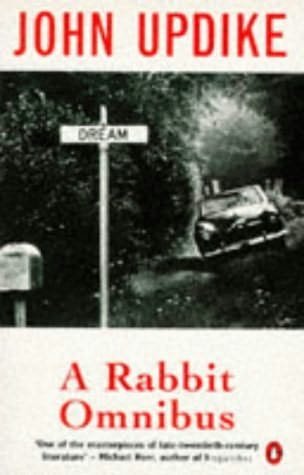
Returning to the haiku tradition for Rabbit Redux:
"Suck it and see" is what
Rabbit might have thought
If he thought at all.
Just finished Rabbit is Rich which I loved. Will post some more about this novel which is now almost 30 years old.
"Suck it and see" is what
Rabbit might have thought
If he thought at all.
Just finished Rabbit is Rich which I loved. Will post some more about this novel which is now almost 30 years old.
Tuesday, January 6, 2009
Wrangling India
It’s worth seeing Slumdog Millionaire just for the Bombay character which is ever-present. The film begins with a long chase scene through the slums; two small boys followed by a policeman. They have been playing cricket on the tarmac of an airport runway. As you do. It’s a great opening sequence that sets up the whole film; these kids are resilient, cheeky survivors in a city that requires these qualities.
Mumbai/ Bombay was the first Indian city I ever went to. Here is what I wrote back in 2000 about arriving:
The next day I planned to go into the “city” to go to the museum. I caught the suburban train. It cost 2 cents. The description above doesn’t do it justice. I missed several trains because they were too full and people sort of waved me off. It took me a while to realise that I was trying to get into the wrong carriage; I should be in the women’s carriages which were at one end of the train. My journey took a long time. It’s no wonder I found India hard going on that trip; there was no cushion of protection from ‘real’ India as I experienced in later trips. It was like being hit over the head with a shovel. I looked at a lot of the scenes in Slumdog Millionaire with a kind of wonderment that I managed it at all. And have been back. And love it.
An English guy, Danny Boyle, made Slumdog Millionaire. I haven’t seen any of his other films. He said that working in India was not like “wrangling India’ as one interviewer suggested; it was like “accumulating India”. It’s a version of “Don’t fight the Ganges”, the very sage advice I learnt on my first trip. The notion of wrangling anything in India is kind of hopeful. Boyle said "I wanted to get (across) the sense of this huge amount of fun, laughter, chat, and sense of community that is in these slums. What you pick up on is this mass of energy." Ironically it's a film about survival when the very process of making the film must have felt about as scary and out of control.
If you accept the film as homage to Bombay, it works about as well as it could. Like being in India you need to go with the heavy melodrama and the obvious villains and innocents. It’s not subtle. The theme of exploitation of slum kids was done a whole lot better by Rohinton Mistry in the novel A Fine Balance and more recently in Animal's People by Indra Sinha. Jamal, the main character in the film, is only interesting for what happens to him and for his doggedness and honesty; he is otherwise without screen exuberance. I probably agree with The New York Times critic Manohla Dargis who says "In the end, what gives me reluctant pause about this bright, cheery, hard-to-resist movie is that its joyfulness feels more like a filmmaker’s calculation than an honest cry from the heart about the human spirit." All true but Boyle gets away with it because of Bombay.
As a postscript, I read Paul Theroux's book The Elephanta Suite recently. I have not loved his writing in the past but I really liked this book which is a collection of three novellas. It's very very self conscious fiction; it's not his comfort zone. It doesn't flow sweetly. But he is wrestling with the encountering of American and Indian cultures and I loved what he was trying to say about the process. Here is a snippet from a review in The Guardian: "Alice, the heroine of the last of these three novellas, 'The Elephant God', a young American woman on a train, feels that Indian novels haven't adequately prepared her for the experience of India. 'Where were the big, fruitful families from these novels, where were the jokes, the love affairs, the lavish marriage ceremonies, the solemn pieties, the virtuous peasants, the environmentalists, the musicians, the magic, the plausible young men?' "That's India for you - big enough for all these stories AND Slumdog and more...
Mumbai/ Bombay was the first Indian city I ever went to. Here is what I wrote back in 2000 about arriving:
“I had been wondering how long it would take for the work 'teeming' to enter the thought process- I had to wait no longer than the Qantas In-flight video where Mumbai was described as "magnificent and teeming" , a "city of contrasts" - great cliché writing. A night journey into Mumbai- hot, heaps of men in the streets, zooming little 3 wheeler auto cabs, no women to be seen anywhere, my driver attempting to keep me awake (4.30 am Melb time) by making a left turn in front of a bus going straight ahead. Buses are invincible in India - just scary in their intent.Unlike a lot of my life, I remember this arrival very vividly. I flew in late at night into a world where people careered round in the little mechanised autocabs. I caught one to my hotel in Juhu, a beachside suburb close to the airport which features a bit in Slumdog Millionaire. Juhu was a strange mix of seeming hipness (lots of bars and clubs) and deadset sleaze. Once inside my hotel room I bounced off the walls. I felt frightened and vulnerable. It was my first time overseas by myself.
A day in Mumbai - caught the train into the 'city' squashed into a carriage full of saris and Jill in her stolid navy! Lovely being with the women and when I finally worked out that I was blocking the way out of the train (10 stops later) they welcomed me and gave me a seat.”
The next day I planned to go into the “city” to go to the museum. I caught the suburban train. It cost 2 cents. The description above doesn’t do it justice. I missed several trains because they were too full and people sort of waved me off. It took me a while to realise that I was trying to get into the wrong carriage; I should be in the women’s carriages which were at one end of the train. My journey took a long time. It’s no wonder I found India hard going on that trip; there was no cushion of protection from ‘real’ India as I experienced in later trips. It was like being hit over the head with a shovel. I looked at a lot of the scenes in Slumdog Millionaire with a kind of wonderment that I managed it at all. And have been back. And love it.
An English guy, Danny Boyle, made Slumdog Millionaire. I haven’t seen any of his other films. He said that working in India was not like “wrangling India’ as one interviewer suggested; it was like “accumulating India”. It’s a version of “Don’t fight the Ganges”, the very sage advice I learnt on my first trip. The notion of wrangling anything in India is kind of hopeful. Boyle said "I wanted to get (across) the sense of this huge amount of fun, laughter, chat, and sense of community that is in these slums. What you pick up on is this mass of energy." Ironically it's a film about survival when the very process of making the film must have felt about as scary and out of control.
If you accept the film as homage to Bombay, it works about as well as it could. Like being in India you need to go with the heavy melodrama and the obvious villains and innocents. It’s not subtle. The theme of exploitation of slum kids was done a whole lot better by Rohinton Mistry in the novel A Fine Balance and more recently in Animal's People by Indra Sinha. Jamal, the main character in the film, is only interesting for what happens to him and for his doggedness and honesty; he is otherwise without screen exuberance. I probably agree with The New York Times critic Manohla Dargis who says "In the end, what gives me reluctant pause about this bright, cheery, hard-to-resist movie is that its joyfulness feels more like a filmmaker’s calculation than an honest cry from the heart about the human spirit." All true but Boyle gets away with it because of Bombay.
As a postscript, I read Paul Theroux's book The Elephanta Suite recently. I have not loved his writing in the past but I really liked this book which is a collection of three novellas. It's very very self conscious fiction; it's not his comfort zone. It doesn't flow sweetly. But he is wrestling with the encountering of American and Indian cultures and I loved what he was trying to say about the process. Here is a snippet from a review in The Guardian: "Alice, the heroine of the last of these three novellas, 'The Elephant God', a young American woman on a train, feels that Indian novels haven't adequately prepared her for the experience of India. 'Where were the big, fruitful families from these novels, where were the jokes, the love affairs, the lavish marriage ceremonies, the solemn pieties, the virtuous peasants, the environmentalists, the musicians, the magic, the plausible young men?' "That's India for you - big enough for all these stories AND Slumdog and more...
Thursday, December 18, 2008
Rabbit again
I don’t remember reading Rabbit Redux when I was young and there is no copy at home. My 2008 copy has an image of a hand holding a chipped mug of coffee on the cover. The fingers are stained with printer’s ink but they look too small to be the hands of a former successful basketballer, as Harry was. Maybe they are the hands of his father who is a small but important character in the book. The image is kind of at odds with the drama of the book; the comforting domesticity of this working class image gives nothing away in terms of a story about the massive changes happening in American socitey, the shifts in the tectonic plates embodied in Harry's drift into experiments with drugs, new sexual partners and black consciousness. All this in Penn Villas, a new housing development on the edge of Brewer, Pennsylvania. (For some alternative covers, go here, here and here. I particularly like the Hangman cover.)
I stopped half way through the novel for a while. Harry spends much of the middle part of the story in a kind of loose vacuum. Like the first novel he is strikingly without agency; he floats into things without making real conscious decisions. Or if he is decisive, it’s quite short–term; should he have sex with Peggy Fosnacht that night? Actually it's not even that far ahead - it's more like should he have sex with Peggy Fosnacht, she has just unzipped her dress? Anatole Broyard, writing in 1971 when the novel was published says:



I stopped half way through the novel for a while. Harry spends much of the middle part of the story in a kind of loose vacuum. Like the first novel he is strikingly without agency; he floats into things without making real conscious decisions. Or if he is decisive, it’s quite short–term; should he have sex with Peggy Fosnacht that night? Actually it's not even that far ahead - it's more like should he have sex with Peggy Fosnacht, she has just unzipped her dress? Anatole Broyard, writing in 1971 when the novel was published says:
“He went back to Rabbit because he knew that it was too easy to have an intellectual or an artist as a hero. There is always a temptation to talk or think things out -- but with a guy like Rabbit, you have to act them out all the way, show what's happening to him, nakedly, without off-stage intellection or interpretation. The thought must be made flesh; the flesh, as in sex, made metaphor; the man in the street tormented into irony. Where Rabbit once ran away, he's now standing his ground, letting the world flow over and around him while he tries to keep his head above water.”
This is a fabulous description of what Updike is about in working with Rabbit.
I think, for a while, I found the drifting hard to read about. And I got sick of the black guy Skeeter. I think Updike wanted this effect but maybe he doesn’t want people to stop reading. I decided to have a break from reading Rabbit then really enjoyed it when I went back to it. Broyard reckons that Harry is climbing out on a limb (any limb, every limb) and swinging – trying to find something in the shifting morass that America is in. and trying to find traction for his own 36 year old self, fast wilting into middle age.
The three defining descriptors of American life in this book are the Vietnam War, the rise of black consciousness and the successful Apollo mission. (Interesting comparison the Space War and the Vietnam War)Other aspects also prevail like the ways in which middle class kids went searching for something different than their parent’s lives. Broyard has a nice way of describing this aspect of the book – Harry hooks up with a barely adult girl for a while: “In Jill, Updike explores the incompleteness -- in them and in ourselves -- that, like a vacuum, draws us toward very young girls.” Aaarrgh so scarily accurate, I think, about men.
I want to include a paragraph about sex so will edit this entry later; he writes so well about this business. What he also does well is the domestic; the fraught ties between Harry and his parents, the guilt and love, the depiction of both his parents is really exquisite. Then at the end, Stage Left: Mim, the sister, living the life not lived. Vivid, in-your-face Updike…
Wednesday, November 26, 2008
Alone in the world
I’ve been thinking about therapy and its literary and filmic representations lately. Purely by coincidence, I saw the films One Flew over the Cuckoos Nest and Men’s Group within a 24 hour period. Both films are broadly about men in trouble, though this is perhaps where the similarity ends.
I think I saw One Flew over the Cuckoos Nest last in 1976. It was quite shocking. Literally of course but that’s a pretty lame joke. I remembered the shocking aftermath of Nicholson’s treatment but not the way the film ended. I don’t know how prevalent lobotomies are any more. I saw it at a time when shock treatment was very controversial as was the institutionalisation of people. I saw it in the free-wheeling 70’s where the mood of rebellion against authority was very strong. I am betting that I saw it just as Whitlam had been kicked out of office and we in Australia were battling against the early, nasty impact of the Fraser government, the razor gang and, interestingly, the first incarnation of John Howard.
Filmsite.org describes it as
I see Nurse Ratched differently though. In some ways, I think she is treated unfairly – this is a film where the only women are whores or nurses and maybe this is how some of these dysfunctional men perceive women in general but it seems a little unfair that Ratched carries the entire can. The doctor, who is a real psychiatrist, is not demonised in the way that Ratched is, though it’s he who is responsible for what finally happens to Nicholson. A nurse, in reality wouldn’t have had that sort of power, even though Ratched is depicted as conducting the therapy sessions by herself. And in the first instance, the Nicholson character is incarcerated in prison because he has had sex with a 15 year old girl; it’s a construct that a director wouldn’t use now if he was looking for audience sympathy for the main character. There is some unpleasant gender stuff lurking in the dark recesses of this film but it is really about dysfunction, abuse of authority and agency.
Critic, Roger Ebert said it “is a film so good in so many of its parts that there's a temptation to forgive it when it goes wrong. But it does go wrong, insisting on making larger points than its story really should carry, so that at the end, the human qualities of the characters get lost in the significance of it all. And yet there are those moments of brilliance.” He and I both liked the small scenes of rebellion inside the ward and the depictions of the ways in which people collude with authority; the scenes showing just how hard it is to take stock, stand up for yourself.
Following my at-home screening of Cuckoo’s Nest, I went to see Men’s Group. I was very disappointed in this film. I had high hopes of this film representing my personal experiences of a women’s group on the big screen; the value of doing the work and the toughness of the experience. And it began promisingly with the very first meeting of the 5 men. This meeting was filled with the confusion and difficulty of making contact with other people; it felt authentic in the strange embarrassment of the session. Their consultant who says, at the outset ”This is not therapy. It’s simply a space to be safe and talk about things.” And this was the truth of the work that he does and that they are up to doing. The consultant seemed unable to work at any depth with the men in the room. They were there for the regular variety of issues that people (men?) face; loneliness, fathering problems, father problems, relationship issues, just generally being disconnected. And why they turned up again after the futility of that first session, I don’t know.
It gave me plenty of time during the film to think about the kinds of successful renderings of therapy on film. The best one for me is the fractious and flirtatious relationship of Dr Jennifer Melfi and Tony (or Anthony, as she likes to call him) Soprano. It is my favourite part of this series. Other people might reference the Analyse This/That films but they are much more about other things than therapy. Pyschotherapist, Irvin Yalom has done so much to render therapy an accessible and interesting thing in fiction and in his books about his practice. I’ve been profoundly influenced by his work. In Love’s Executioner he talks about 4 fundamental things that we need to come to terms with as humans. The first is obviously death. Another is our fundamental aloneness – not loneliness but aloneness. I can’t remember what the other two are but these two are big for me. Here is a little of an interview with him in Salon:
I think I saw One Flew over the Cuckoos Nest last in 1976. It was quite shocking. Literally of course but that’s a pretty lame joke. I remembered the shocking aftermath of Nicholson’s treatment but not the way the film ended. I don’t know how prevalent lobotomies are any more. I saw it at a time when shock treatment was very controversial as was the institutionalisation of people. I saw it in the free-wheeling 70’s where the mood of rebellion against authority was very strong. I am betting that I saw it just as Whitlam had been kicked out of office and we in Australia were battling against the early, nasty impact of the Fraser government, the razor gang and, interestingly, the first incarnation of John Howard.
Filmsite.org describes it as
“one of the greatest American films of all time - a $4.4 million dollar effort directed by Czech Milos Forman. Its allegorical theme is set in the world of an authentic mental hospital (Oregon State Hospital in Salem, Oregon), a place of rebellion exhibited by a energetic, flamboyant, wise-guy anti-hero against the Establishment, institutional authority and status-quo attitudes (personified by the patients' supervisory nurse). [Forman himself noted that the asylum was a metaphor for the Soviet Union (embodied as Nurse Ratched) and the desire to escape.”The film holds up but looks quite different to me now. I have a greater appreciation of where Milos Forman was coming from. He says in the support material for the film that he felt like he had been living in an asylum for 20 years in the Czech Republic. Most of the filming was done in the mental hospital; the actors would come in the morning and rehearse then just hang around getting themselves into the feel of the institution in the afternoon.
I see Nurse Ratched differently though. In some ways, I think she is treated unfairly – this is a film where the only women are whores or nurses and maybe this is how some of these dysfunctional men perceive women in general but it seems a little unfair that Ratched carries the entire can. The doctor, who is a real psychiatrist, is not demonised in the way that Ratched is, though it’s he who is responsible for what finally happens to Nicholson. A nurse, in reality wouldn’t have had that sort of power, even though Ratched is depicted as conducting the therapy sessions by herself. And in the first instance, the Nicholson character is incarcerated in prison because he has had sex with a 15 year old girl; it’s a construct that a director wouldn’t use now if he was looking for audience sympathy for the main character. There is some unpleasant gender stuff lurking in the dark recesses of this film but it is really about dysfunction, abuse of authority and agency.
Critic, Roger Ebert said it “is a film so good in so many of its parts that there's a temptation to forgive it when it goes wrong. But it does go wrong, insisting on making larger points than its story really should carry, so that at the end, the human qualities of the characters get lost in the significance of it all. And yet there are those moments of brilliance.” He and I both liked the small scenes of rebellion inside the ward and the depictions of the ways in which people collude with authority; the scenes showing just how hard it is to take stock, stand up for yourself.
Following my at-home screening of Cuckoo’s Nest, I went to see Men’s Group. I was very disappointed in this film. I had high hopes of this film representing my personal experiences of a women’s group on the big screen; the value of doing the work and the toughness of the experience. And it began promisingly with the very first meeting of the 5 men. This meeting was filled with the confusion and difficulty of making contact with other people; it felt authentic in the strange embarrassment of the session. Their consultant who says, at the outset ”This is not therapy. It’s simply a space to be safe and talk about things.” And this was the truth of the work that he does and that they are up to doing. The consultant seemed unable to work at any depth with the men in the room. They were there for the regular variety of issues that people (men?) face; loneliness, fathering problems, father problems, relationship issues, just generally being disconnected. And why they turned up again after the futility of that first session, I don’t know.
It gave me plenty of time during the film to think about the kinds of successful renderings of therapy on film. The best one for me is the fractious and flirtatious relationship of Dr Jennifer Melfi and Tony (or Anthony, as she likes to call him) Soprano. It is my favourite part of this series. Other people might reference the Analyse This/That films but they are much more about other things than therapy. Pyschotherapist, Irvin Yalom has done so much to render therapy an accessible and interesting thing in fiction and in his books about his practice. I’ve been profoundly influenced by his work. In Love’s Executioner he talks about 4 fundamental things that we need to come to terms with as humans. The first is obviously death. Another is our fundamental aloneness – not loneliness but aloneness. I can’t remember what the other two are but these two are big for me. Here is a little of an interview with him in Salon:
Q: “Most of us feel we do not want to think about death. But you assert that confronting death is a key to living a full, authentic, happy life. I wonder if you could describe in personal terms what living authentically means to you?”
A: “Certainly as I've grown older, I've been thinking a lot more about the end of my life, which may not be too far away. My father and his brothers all died relatively young because of heart conditions. So I think, Well, life is finite. I don't have unlimited years left, and I want to know what is more central to me and my life right now.Above all, I don't want to do anything that feels repetitious. And I tell myself that I don't want to belong to any more committees or teach anymore, because the field is becoming drugs, pharmacotherapy. The next generation of therapists isn't going to be trained for psychotherapy because the insurance companies aren't going to be paying for it any longer.
What feels most central for me is being creative and looking at the way in which I have creative talents and gifts that I haven't used. I basically see myself as a storyteller engaged in ideas that have to do with an existential, deeper approach to life. I feel very uncomfortable with the idea of these gifts being unused.”
It reminded me of going to hear David Tacey and John Carroll talk about Jung at Readings. One of them said that in this secular society, we use stories to make meaning out of life. This statement sounds so painfully obvious but when I heard it, it resonated so much - this is the compelling thing about stories, in the absence of that large meta-narrative about God, we need some others. (The blog Thinking Shift has some writing about this topic.)
I think that when it comes down to it, this is why I felt so cross with Men’s Group. The film fluttered across the surface of the stories of these men; all of whom had deep and painful histories. The film-maker, Michael Joy, said “Within my own life I ended up needing some people outside of family and friends to talk to and I found myself going to a men's group this one evening and heard these guys' stories and just realised that there was a story there that had to be told.” Joy needed to hang around and do the stories justice. He needed to attend the men’s group for months to see what deep and painful issues were raised and worked through. If they were worked through. Or to read a little Yalom and see what universal truths can come from the process of therapy whne you stay with the pain of the person you are working with, when you linger.
So out of it all, when I talked about it with Naomi, my FFFF, we decided that there was merit in showing the fact that the 5 men were facing similar issues (as opposed to making a film about any one one of these characters seperately). Loneliness. Disconnection. Inarticulateness. Aggression. How to be a father. How to love a father. How to manage that sense of being alone in the world. These are the stuff of important stories; they make meaning for everyone. But while there is great merit in trying to work with these themes, the film did a pretty crap job of it.
It did, however, spawn this funny piece of dialogue between Margaret and David (At the Movies):
MARGARET: Getting away from that, I mean it’s interesting for me, having that sort of rawness of blokes’ emotions. How do you, as a man, react to that?
DAVID: I found it - I think I’m the sort of person who keeps my emotions in check.
MARGARET: Yeah.
DAVID: And so I don’t entirely recognise that, but I was impressed by the way the actors handled it and the way it developed during the course of the film. I would never go to a group session like the one in the film. Never.
MARGARET: I can imagine. No, but because, you know, I think that’s true of a lot of men. They’re too contained and they are in the beginning of this film.
DAVID: You’re looking...
MARGARET: It’s not easy to expose yourself.
DAVID: You’re looking at a very contained man, Margaret.
MARGARET: Oh, I know that, David.
DAVID: In case you didn’t know after all these years.
Thursday, November 13, 2008
Taking no prisoners
“Visceral: 1: felt in or as if in the viscera, deep, 2: not intellectual : instinctive , unreasoning,I seem to use the word “visceral” a lot more lately. If someone had asked me what it meant, I think I would have said “bloody, tangible, of the body” with an edge of violence. But maybe this is because it is often used about violent scenarios. Brainyquote has a number of examples of ways that other people have used the word including Penn Jillette who said “When you're watching Psycho, there's that moment when you have a visceral reaction to watching someone being stabbed. And then you have the intellectual revelation that you're not, and that's where the celebration comes in.” Then I was kind of surprised when I looked up the Macquarie and their definition related solely to the biological: “soft interior organs in the cavities of the body, eg the brain, lungs, heart, stomach and intestines”.3: dealing with crude or elemental emotions, 4: earthy."
The word certainly came to mind a lot when I was watching the film Hunger. Seeing this film is like been run over. In a very sophisticated way. It is very, very violent, as you would expect in a film about a prison. It’s about the decision of IRA prisoner Bobby Sands to go on a hunger strike in 1981 to protest the fact that IRA prisoners were being treated like the criminal class of prisoners by the prison authorities.
I vaguely remember this in the news but little about the story. It is just one large fragment in the very long and fuzzy set of news clips that form my understanding of Northern Ireland’s politics. A 31 year-old colleague had never heard of the IRA. She’s not uneducated; it‘s just that “the troubles” have been sorted to some extent and Northern Ireland is no longer a key part of daily news bulletins. When Bobby Sands was starving himself to death, I was learning to teach in Swan Hill; I had other things on my mind.
The film opens with a set of images and sounds that take the viewer right into the guts of the prison. (Guts- visceral!!!) You hear rather than see a rattling of pots and pans in a protest rally. The noise becomes deafening, nearly unbearable, even as the close-ups of the items being banged look like pieces in a factory assembly line, then we experience some of the daily rituals through a prison officer who soaks his bloody knuckles in water and checks the undercarriage of his car for bombs before leaving for work. This is the almost the only time we experience events outside the prison except for voice-overs by Maggie Thatcher that contextualise the British Government’s position and one other challenging scene that helps to further unsettle us.
The film is very claustrophobic; the action is both internal to the prison and internal to the body. It’s a film which seeks to explore what happened at one historical point in time, to one person, without providing much surrounding context. This is a very interesting strategy. We learn almost nothing about the larger context except that both the IRA and the British authorities were extremely violent in pursuit of their conflicting goals. I like the fact that it is so concentrated but wonder how it might be interpreted by people who know nothing about the politics. In this case it becomes almost solely a film about the decision to use your body as a tool for political activism. Does a man have the right to kill himself and lead others to their own suicides? Will it accomplish anything? Won't this just play into the hands of Margaret Thatcher? The broader range of questions which we might now apply to suicide bombers or to asylum seekers who sew their lips together etc.
The visceral part? The hunger strikers had tried a “no wash” campaign which included smearing their own shit on the walls of the cells and flooding the hallways with urine. They are forcibly washed by guards. There are maggots. The feeling of being in this with them is intensifies by the lack of dialogue which pervades the first third of the film. There is a lot of silence which heightens the impact for other senses.
This is the first film for director Steve McQueen who is apparently an accomplished and well known visual artist. The visuals are really compelling. He pictures the inmates in one scene as a large group of Jesus like figures – they have long hair, beards and bare chest and their gauntness reminds me of the many, many images of Christ on the cross. This image is reinforced towards the end of the film when Bobby Sands collapses in the bathroom and is carried back to bed by a guard, Pieta style. And towards the end of the film, we begin to occupy Sand’s body, maybe devouring it in the way that some organs might be cannibalising other parts of the body in a kind of hideous and desperate attempt to stay alive. We hear and see the world in a fuzzy disconnected way as Sands is dying. His body is covered with suppurating sores. It’s pretty ghastly and hard to sit through.
Many reviewers have commented on the set-up of the film- in 3 acts with an extraordinary dialogue in the middle between Sands and a priest. It’s not necessary for me to describe that here except that it’s brave to expect an audience to stay the distance. This part enables us to understand why Sands has decided to take this course of action. "Putting my life on the line isn't the only thing I can do—it's the right thing." It tells us a little of Sands’ background; from an early age, he has been able to make tough decisions.
This long scene is characteristic of the whole film in that I felt for Sands but not in a deep emotional way- I was horrified by what happened to him, by the choice that he felt he had to make, horrified by the conditions in the prison, by the brutality of life for everyone in the prison (guards and prisoners) but film style is extremely dispassionate. Because of the sort of person I am, I usually like to connect with the characters – this enables me to feel things deeply and I don’t think the film provides this opportunity to any extent. It doesn’t diminish the film but has made me reflect about how film–makers get into your psyche and what the most effective techniques are.
For me, the film Wendy and Lucy, which I saw at the film festival, does this best. That film forced the viewer to experience the same anxieties and tension as the main character, by moving slowly through her emotional landscape, feeling her vulnerability and the strength of character. Maybe in Hunger, we just experience the strength of character and not the vulnerability and this is why I am not as emotionally connected. WE can see that their bodies are vulnerable but they are so tough in the face of the brutality that it's hard to feel the emotional force of the experience.
Despite this, I admire the film and the director. It’s powerful and interesting. It takes no prisoners. It's worth the difficulty of sitting through.
Subscribe to:
Posts (Atom)